
Does KPV have human evidence?
FDA found no clinical trial, pharmacokinetic study, case report or documented human exposure to KPV; cell, cadaver-skin and animal studies do not establish efficacy, dosing or safety.
Published
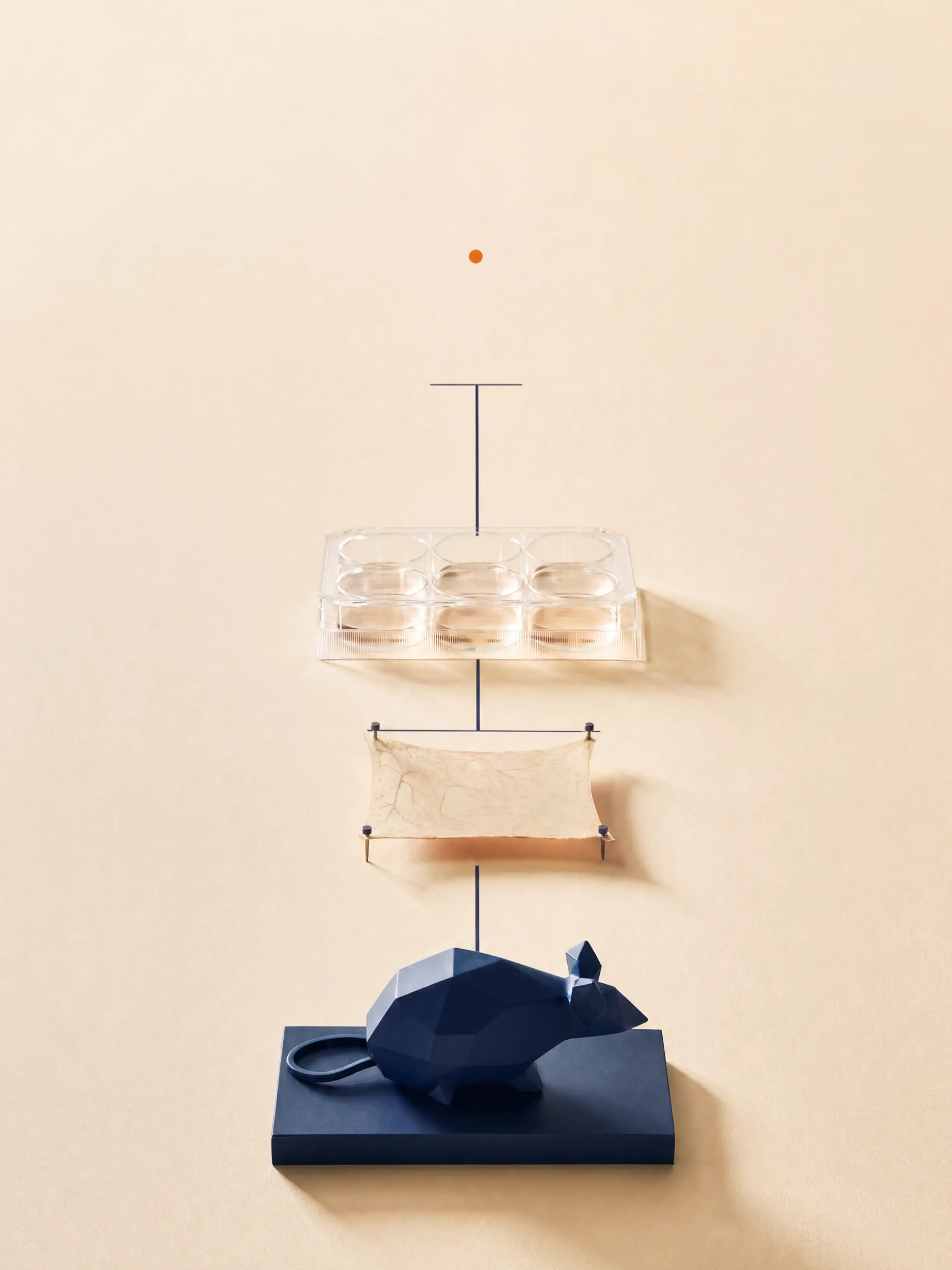
KPV has a laboratory literature and an online market. It does not yet have a documented clinical evidence base.
In its May 2026 review, FDA found no study in which KPV free base or KPV acetate was administered to a person. The agency found no clinical pharmacokinetic study, no case report and no human exposure record by any route. A fresh ClinicalTrials.gov search on 3 August returned no registered KPV study.
That answer is stronger than human trials are limited. It is also narrower
than KPV does nothing. Cells, excised human tissue and animals can support
biological plausibility. They cannot establish that a finished product benefits
or is safe for people.
KPV is short, but the evidence problem is not
KPV stands for lysine-proline-valine. It is a three-amino-acid fragment of alpha-melanocyte-stimulating hormone, a larger endogenous peptide involved in several biological pathways.
Online descriptions often move directly from that origin to claims about gut inflammation, skin, wound healing, immune regulation and recovery. The missing step is administration to living people in a study of a characterized product. Establishing efficacy would additionally require predefined outcomes and a suitable comparator.
FDA evaluated two substances: KPV free base and KPV acetate. They are distinct bulk drug substances, not interchangeable labels. Neither is a component of an FDA-approved drug or covered by a USP or NF drug-substance monograph.
The agency also found inconsistent naming and incomplete information about
identity, impurities, aggregation and microbiological quality. This matters
because Does the molecule have an effect?, Does a product deliver it? and
Is the finished product safe and consistent? are three separate questions.
The most cited gut paper used cells and mice
A 2008 Gastroenterology study is central to KPV’s gut story. Researchers used human intestinal epithelial cell lines and a human T-cell line to study uptake and inflammatory signaling. They then delivered KPV orally in two mouse models of chemically induced colitis.
The cell experiments linked KPV uptake to the PepT1 transporter and reported lower inflammatory signaling and cytokine secretion. In mice, KPV reduced several signs and markers of experimental colitis.
Those findings are legitimate preclinical evidence. They are not a human IBD trial. A human-derived cell line is not a patient, mouse colitis is not the full clinical disease, and a concentration used in a model is not a human dose.
Newer research has made delivery systems more sophisticated. KPV has been combined with hydrogels, nanomaterials, other active agents and engineered carriers in cells and animals. In 2026, one paper reported KPV effects on lipid accumulation in HepG2 cells, while another Science Advances paper developed an inflammation-responsive oral peptide-delivery system.
The science is moving. The documented human-study denominator remains zero.
Human cells and human evidence are not synonyms
Search results can make the record look more clinical than it is. Papers may be indexed with human terms because they use human bronchial, intestinal, immune or liver-derived cell lines.
Another study used excised human cadaver skin to test KPV delivery. KPV crossed intact skin poorly; iontophoresis or microporation increased passage. That experiment can inform formulation research. It cannot show that a cream closes a wound faster, improves a skin disease or is tolerated in living people. The study is available through its PubMed record.
This distinction resolves the apparent contradiction:
| Evidence label | What was actually studied | Human participants | Supported conclusion |
|---|---|---|---|
| Human intestinal evidence | Human-derived cell lines plus mouse colitis | 0 | Mechanism and animal hypothesis |
| Human skin evidence | Excised cadaver skin | 0 | In-vitro permeability |
| Wound-healing evidence | Primarily rodent tissue and wound models | 0 | Preclinical plausibility |
| ClinicalTrials.gov | Registry search on 3 August 2026 | 0 KPV studies | No registered clinical program located |
| FDA clinical review | Multiple medical and regulatory databases | 0 administered-human records found | Human efficacy and safety remain uncharacterized |
Zero adverse-event reports do not establish safety
FDA searched its adverse-event database through 3 December 2025 and found no KPV reports. Its food and supplement complaint search also found no case in which KPV had been administered.
That is not a clean safety record. Reporting is incomplete, and traditional section 503A compounders generally do not report adverse events to FDA. Without a known number of exposed people, a verified product and systematic follow-up, zero reports cannot estimate risk.
FDA found no clinical study assessing KPV pharmacokinetics or pharmacodynamics by any route. Potential interactions, common side effects, rare events, dose response and long-term outcomes therefore remain unknown.
Peptides can also aggregate or trigger immune responses depending on identity, purity, formulation, storage and route. FDA found no KPV-specific human data capable of excluding those risks.
Unknown is not the same as dangerous. It is also not the same as safe.
The FDA committee vote did not add human evidence
FDA staff proposed against adding KPV free base and KPV acetate to the section 503A Bulks List. The staff review cited poor characterization, unknown compounding history and the absence of human effectiveness and safety data.
On 23 July 2026, the Pharmacy Compounding Advisory Committee voted 8–6–1 to
recommend listing each form. The committee’s advice differed from staff’s
proposal.
The vote did not approve KPV, establish a clinical benefit, supply a dose or change the operative list by itself. Final FDA action remained pending on 3 August 2026. KPV also remained in FDA Category 2, outside Category 1 interim enforcement discretion.
That split is important. A compounding-policy recommendation asks a different question from a drug-approval review. Neither side of the vote created a human trial result.
The newest papers make KPV timely—not proven
KPV deserves editorial attention because three things are happening at once:
- Commercial pages rank for broad benefit and dosing searches.
- New preclinical papers keep expanding mechanisms and delivery systems.
- The July 2026 advisory vote created a new regulatory storyline.
The strongest current conclusion remains simple: no administered-human evidence was located, so efficacy, clinical dosing and safety are not established.
Primary sources
- FDA evaluation of KPV free base and KPV acetate
- FDA July 2026 meeting page and archived webcast
- FDA section 503A process and current-list page
- Dalmasso et al., KPV uptake and mouse-colitis study
- Land, KPV in human bronchial epithelial cells
- Pawar et al., KPV permeation through excised human cadaver skin
- Lee et al., 2026 HepG2 cell study
- Cheng et al., 2026 preclinical oral-delivery study
- FDA Category 2 bulk substances
- ClinicalTrials.gov KPV search
Independent editorial summary. The authors and organizations are not affiliated with LifeScore.
The lifescore take
KPV is a clean example of how a scientific story can grow before a clinical story begins. The next meaningful update is not another cell pathway, animal carrier or seller protocol. It is administration to living people in a registered study with a characterized product, justified route and systematic safety collection. Demonstrating efficacy would additionally require predefined outcomes and a comparator capable of showing what would have happened without KPV. Until then, `promising preclinical research` and `supported human treatment` are different categories. The distance between them is the story.
For editors and researchers
Cite this article
- Author
- lifescore Edge
- Publisher
- lifescore
- Published
- Updated
- Not updated
Canonical citation
Stable URL: https://lifesco.re/edge/does-kpv-have-human-evidence/
Primary source
FDA evaluation of KPV free base and KPV acetate
Independent editorial summary. The authors are not affiliated with LifeScore.
Edge delivery
Get new Edge articles in your inbox.
Evidence-led insights, delivered when published.