
Does oral semaglutide match injectable semaglutide for weight loss?
Separate placebo-controlled trials put the approved 25 mg tablet near the 2.4 mg weekly injection, but oral exposure varies more, the routines differ and no direct obesity trial proves equivalence.
Published
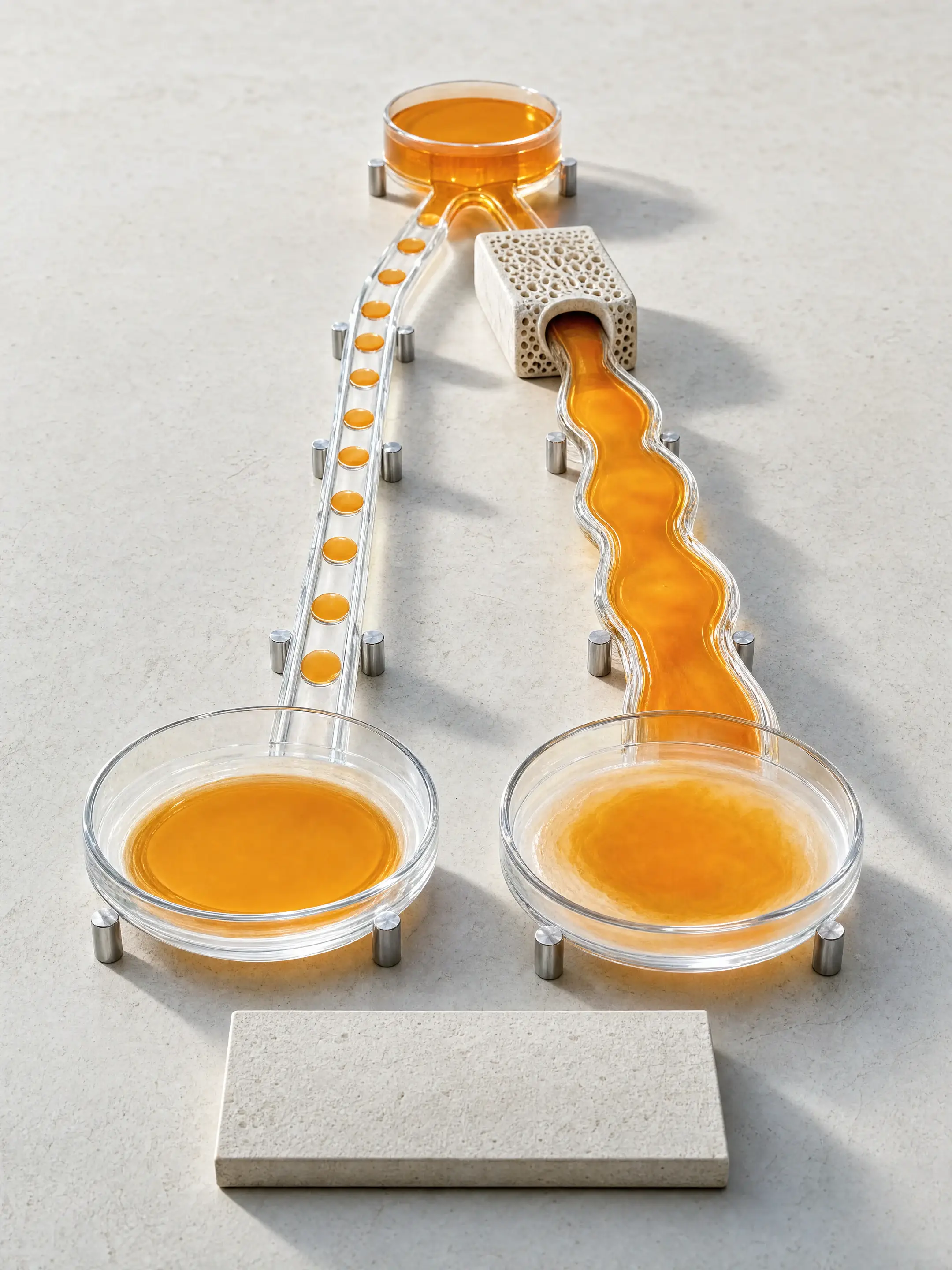
Oral and injectable Wegovy contain the same active substance: semaglutide. In separate obesity trials, the approved 25 mg daily tablet and the familiar 2.4 mg weekly injection produced close average weight reductions.
That is a meaningful comparison, not proof that the two routes match. OASIS 4 tested the tablet against placebo. STEP 1 tested the injection against placebo. No participant was randomized between the two formulations, and no equivalence margin was tested.
The current US label adds a second complication. It now permits a 7.2 mg weekly injectable maximum for some adults. That higher dose outperformed 2.4 mg in a direct injection-versus-injection trial and has not been compared directly with the tablet.
The comparison must stay with the same molecule
Oral GLP-1 and GLP-1 injection are categories, not treatments. Comparing
different molecules, doses or product identities would mix a route effect with
drug effects.
The narrow question here is oral Wegovy 25 mg versus injected Wegovy in the current US label. It does not substitute oral Rybelsus doses, Ozempic diabetes doses, compounded preparations or another oral GLP-1 drug. Same category is not same molecule; same molecule is still not same delivery.
The approved 25 mg tablet produced a 13.6% mean reduction
OASIS 4 was a 71-week, double-blind trial at 22 sites in four countries. It randomized 307 adults without diabetes who had obesity, or overweight with a weight-related condition. Two hundred five received oral semaglutide escalated to 25 mg once daily and 102 received placebo, both with lifestyle intervention.
At week 64, estimated mean weight change was -13.6% with the tablet and -2.2% with placebo. The estimated difference was -11.4 percentage points, with a 95% confidence interval from -13.9 to -9.0.
Gastrointestinal adverse events were reported by 74.0% of the oral-semaglutide group and 42.2% of the placebo group. OASIS 4 establishes that 25 mg oral semaglutide outperformed placebo in the studied population. It had no injection arm.
Novo Nordisk funded the trial and employed three listed authors. That does not erase the randomized result; it makes design, analysis and disclosure part of how the evidence is read.
The closest injection trial produced 14.9% at 2.4 mg
STEP 1 randomized 1,961 adults without diabetes to weekly injected semaglutide 2.4 mg or placebo for 68 weeks, again with lifestyle intervention.
Mean weight change was -14.9% with semaglutide and -2.4% with placebo. The estimated difference was -12.4 percentage points, with a 95% confidence interval from -13.4 to -11.5. Gastrointestinal events caused treatment discontinuation in 4.5% on semaglutide and 0.8% on placebo.
The raw trial headlines look close:
| Formulation and trial | Randomized population | Endpoint | Estimated mean weight change | Placebo change |
|---|---|---|---|---|
| Oral 25 mg, OASIS 4 | 307 adults without diabetes | Week 64 | -13.6% | -2.2% |
| Injection 2.4 mg, STEP 1 | 1,961 adults without diabetes | Week 68 | -14.9% | -2.4% |
But the rows are not two arms of one experiment. STEP 1 was much larger and ended four weeks later at its primary weight endpoint. The trials recruited different people, at different sites and times, and used their own adherence, missing-data and rescue-treatment patterns.
Overlapping results can make a direct comparison worth testing. They do not demonstrate equivalence. That would require a randomized oral-versus-injection design with a prespecified margin.
The label says average exposure is comparable—not identical
The delivery mechanisms are materially different.
The injection has 89% absolute bioavailability. The oral tablet has an estimated 1% to 2% and includes the absorption enhancer SNAC. According to the FDA label, the tablet is absorbed predominantly in the stomach.
Despite that gap, dose size brings average exposure close. The label reports average steady-state semaglutide concentrations of about 77 nmol/L with oral 25 mg daily and 75 nmol/L with injected 2.4 mg weekly in adults with obesity or overweight.
The distribution is not close in the same way. For adults without type 2 diabetes, FDA predicts that 90% of average concentrations fall between 27 and 186 nmol/L with the tablet, versus 51 to 110 nmol/L with the 2.4 mg injection. Oral exposure is much more variable.
Comparable average concentration therefore supports the plausibility of the similar trial headlines. It does not mean every person receives the same exposure or that clinical equivalence has been demonstrated.
Daily fasting rules are part of the oral formulation
The current US label says the tablet is taken once daily in the morning on an empty stomach, with no more than 4 ounces of water and no other liquid. It is swallowed whole, followed by at least 30 minutes before food, drinks or other oral medicines.
The weekly injection can be given at any time of day, with or without meals.
These are not cosmetic instructions. FDA’s pharmacokinetic section reports greater oral absorption with less water in one single-dose study and with a longer post-dose fasting period in another. The route changes the routine that produces exposure.
The label also contains formal switching instructions between oral 25 mg and injected 2.4 mg. That is regulatory dosing information built on the total evidence package. It is not a randomized clinical result showing equal weight loss, and it is not individualized switching advice.
A new 7.2 mg injection sets a higher bar
The current label lists 1.7 mg or 2.4 mg as usual adult injectable maintenance doses. For adults who tolerate 2.4 mg for at least four weeks and for whom additional weight reduction is clinically indicated, it permits a maximum of 7.2 mg weekly.
STEP UP directly randomized 1,407 adults with obesity without diabetes to 7.2 mg, 2.4 mg or placebo for 72 weeks. Mean weight change was -18.7%, -15.6% and -3.9%, respectively. The estimated 7.2-versus-2.4 difference was -3.1 percentage points, with a 95% confidence interval from -4.7 to -1.6.
Gastrointestinal adverse events were more common at 7.2 mg than at 2.4 mg or placebo, and dysesthesia was reported more often at the higher dose.
This is a real head-to-head result—but only between injection doses. Oral 25 mg has neither been randomized against 7.2 mg nor shown comparable exposure to it. The label reports an average concentration of about 230 nmol/L at 7.2 mg, roughly three times the averages reported for oral 25 mg or injected 2.4 mg.
The 50 mg oral headline is not the approved-tablet result
Some comparisons still cite OASIS 1, which tested 50 mg oral semaglutide in 667 adults without diabetes. At week 68, estimated mean weight change was -15.1% with oral semaglutide and -2.4% with placebo.
That trial is useful evidence about oral dose development. It does not describe the approved US maintenance dose reviewed here, which is 25 mg. Using its 15.1% headline as the approved tablet result silently changes the dose.
Original sources
- FDA, current Wegovy prescribing information, revised May 2026
- Wharton et al., OASIS 4 oral 25 mg trial
- Wilding et al., STEP 1 injected 2.4 mg trial
- Wharton et al., STEP UP 7.2 mg versus 2.4 mg trial
- Knop et al., OASIS 1 oral 50 mg trial
Independent editorial summary. The authors, trial investigators, sponsor, regulator and journals are not affiliated with LifeScore. Novo Nordisk funded the OASIS and STEP trials summarized here and employed several listed authors. This article does not provide medical, dosing, switching or treatment advice.
The lifescore take
The tablet-versus-injection question has an unusually tempting shortcut: put 13.6% beside 14.9% and declare a tie. The evidence earns a more exact answer. Oral Wegovy 25 mg and injected Wegovy 2.4 mg are the same molecule delivered through different routes. Their average exposures are close in the labeled population, and their separate placebo-controlled trials produced close mean weight reductions. That makes similar efficacy plausible. It does not prove a match. Oral exposure is more variable, the fasting routine is part of delivery, and no direct obesity trial randomized the two formulations. The newer 7.2 mg injection also sits outside the apparent tie: it outperformed 2.4 mg directly and has no oral head-to-head. The honest comparison is therefore near 2.4 mg in separate trials, not equivalent to injection.
For editors and researchers
Cite this article
- Author
- lifescore Edge
- Publisher
- lifescore
- Published
- Updated
- Not updated
Canonical citation
Stable URL: https://lifesco.re/edge/does-oral-semaglutide-match-injectable-semaglutide-for-weight-loss/
Primary source
Oral Semaglutide at a Dose of 25 mg in Adults with Overweight or Obesity
Wharton et al. The New England Journal of Medicine. Published 2025. DOI 10.1056/NEJMoa2500969.
Independent editorial summary. The authors are not affiliated with LifeScore.
What this does not establish. OASIS 4 and STEP 1 were separate placebo-controlled trials, not a randomized oral-versus-injection comparison. Comparable average exposure does not establish individual exposure or clinical equivalence.
Edge delivery
Get new Edge articles in your inbox.
Evidence-led insights, delivered when published.