
What does a visible luxury logo signal?
Prominent marks can raise perceived status, but experiments also find a warmth penalty when observers infer showing off; the logo alone cannot reveal wealth, motive or insecurity.
Published
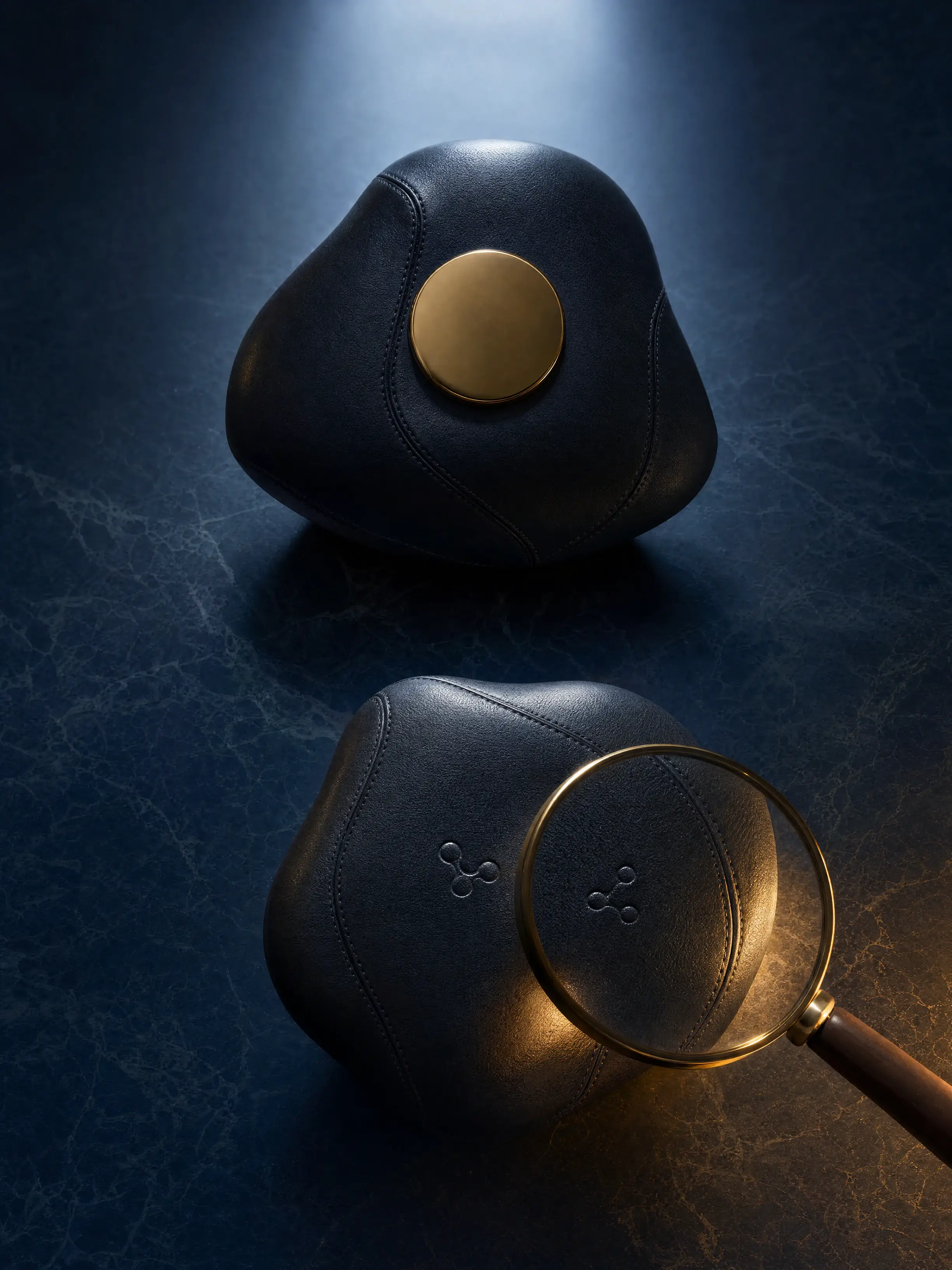
A luxury logo is easy to see and tempting to overread. One observer sees success. Another sees effort. A third recognizes nothing at all.
The research supports the first step of that story: visible luxury marks can act as status cues. It does not support the leap from cue to diagnosis. A logo cannot tell a stranger whether its wearer is wealthy, indebted, confident, insecure, authentic, compensating or simply likes the object.
What the mark communicates depends on who sends it, who can decode it, where it appears and which judgment matters next. The same display can raise perceived status or competence and reduce perceived warmth.
Brand prominence changes who can read the signal
Marketing researchers use brand prominence for the conspicuousness of a mark
or logo on a product. A repeated monogram or oversized name is loud. A shape,
stitch or small internal mark that only an informed observer recognizes is
quiet.
The foundational 2010 study did not begin with a personality test. It began with products. Researchers collected online data for 236 Louis Vuitton and 229 Gucci handbags, plus smaller shoe and Mercedes comparisons. Within those selected lines, quieter variants tended to cost more after the analyses controlled for measured product features. Among 47 Mercedes models, an extra centimeter of emblem size was associated with a price decrease of slightly more than $5,000 after vehicle body type was controlled.
That does not mean a small badge causes prestige. Price, materials, design and brand strategy move together. It does show that high price and maximum logo visibility were not synonyms inside those product lines.
The counterfeit market made the signal split more visible. Of 465 authentic handbag styles, 211 had been copied in the data set. Copied styles had more prominent marks than styles left alone. When price and prominence entered the same model, prominence predicted whether a style was copied while price did not. Copying patterns tracked prominence more closely than retail price in this data set. The analysis did not establish what counterfeiters intended.
A quiet signal still needs a decoder
The 2010 researchers then compared two groups of 60 California consumers. One group was recruited from an unusually high-income area; the other was not. Participants ranked the likely prices of prominent and subtle handbags under label-present or label-absent conditions.
The high-income group’s rank distributions were similar across those two conditions. In the other population, distributions differed for four of six comparisons. Different respondents saw the labeled and unlabeled versions, so this was not a within-person reveal. In debriefing, knowledgeable participants described details such as handle bases, stitching and hardware.
In Han and colleagues’ model, the signal is not absent. It is narrow. It trades mass recognition for recognition by people who know the code.
Income was a recruitment shortcut in one regional study, not a law of human perception. Expertise can come from work, interest, culture, retail exposure or counterfeit knowledge. What matters is that a signal only works if the intended audience can read it.
Loud and quiet preferences were not just about money
In another 120-person study, the researchers split respondents by reported income and need for status, then asked them to choose between otherwise similar loud and quiet handbags. The high-income, lower-status-need group had an estimated 14% probability of choosing loud. The two higher-status-need groups were at 71.6% and 74.7%. The lower-income, lower-status-need group was indifferent at 50%.
The paper gave these four cells memorable class labels. The underlying method was less absolute: regional respondents, median splits on two self-reported variables and one product category. The authors themselves warned that preference could change with the product and occasion.
So the finding is not “rich people hide logos.” It is that prominence can match different audience and affiliation goals. A quiet mark can seek recognition inside a knowledgeable group. A prominent mark can seek legibility across a wider one.
Visible logos can change how people are treated
Three later experiments in South Korea compared clothing with a luxury, non-luxury or no logo. In the first, the luxury mark raised perceived wealth and status. The later studies reported more favorable interpersonal treatment and, in a fundraising setting, larger donations to a requester displaying a luxury logo.
Those findings make status signaling consequential. They are not universal. The experiments used selected brands, student-heavy samples and a particular cultural setting. A logo that produces deference in one interaction can produce skepticism in another.
Status can rise while warmth falls
Four experiments published in 2019 exposed the core trade-off. Luxury display raised perceived status but lowered perceived warmth. The lower-warmth judgment tracked the belief that the person was trying to impress or show off; envy did not explain the pattern.
That creates two possible outcomes from one cue. If a decision rewards status, the display can help. If it depends on approachability, trust or affiliation, the warmth penalty can matter more.
Five workplace studies sharpened the point. Luxury cues around higher-status people such as managers could reduce reactions through lower warmth. Around lower-status employees, the same broad category of cue could improve reactions through inferred competence. Observer role, target rank, logo prominence and evidence of impression management changed the result.
Newer experiments in social interaction and social media reached a similar split. Luxury consumption increased perceived competence through perceived status, while it reduced warmth through an inferred status-signaling motive. When researchers compared wealth alone with wealth plus luxury, the added luxury cue reduced warmth without adding competence.
The logo does not carry one fixed social score. It enters a decision with multiple dimensions.
| What the observer notices | Possible inference | What the evidence does not establish |
|---|---|---|
| Prominent luxury mark | Recognizable status claim | Actual income, debt or ownership authenticity |
| Subtle brand-specific cue | In-group knowledge or selective affiliation | Superior taste or higher human worth |
| Luxury in a status-relevant setting | Status or competence | Suitability for every role or relationship |
| Luxury in a warmth-relevant setting | Impression management or distance | The wearer’s private motive |
| Luxury that feels mismatched to the user | Inauthenticity for some consumers | Insecurity visible to strangers |
Inauthenticity is real, but it is not visible on the logo
Seven field and laboratory studies examined the consumer’s side of the experience. They included patrons of the Metropolitan Opera, people on Martha’s Vineyard, luxury-shopping contexts, high-earning consumers and participants recalling products they owned.
Luxury could promise attention and better treatment while making some participants feel less true to themselves. The researchers linked that response to seeing the product as an undue privilege. People higher in measured psychological entitlement, or temporarily made to feel more entitled, showed a smaller inauthenticity effect.
That is evidence that luxury can create an internal mismatch. It is not evidence that observers can diagnose the mismatch from a bag, watch or shirt. The studies measured what consumers reported or did under specific conditions. They did not validate a logo-based insecurity test.
The distinction matters:
- A person displays a cue.
- An observer infers a motive or trait.
- The person may report a private experience.
- A study may or may not verify an enduring trait.
Most luxury-logo research studies steps one through three. Online commentary often jumps straight to four.
Primary sources
- Han, Nunes and Drèze, brand prominence and status signaling
- Lee, Ko and Megehee, social benefits of displayed brand logos
- Cannon and Rucker, social costs of luxury consumption
- Lee and Bolton, luxury signals in workplace status
- Goor et al., impostor syndrome from luxury consumption
- Liu et al., status, competence and warmth
Independent editorial summary. The authors are not affiliated with LifeScore.
The lifescore take
A status signal is a relationship, not an object. It has a sender, a message, a decoder, a setting and a decision. Change any one of them and the same mark can mean something else. Prominent luxury logos can communicate status because they are recognizable. Quiet cues can communicate status more selectively because fewer people can read them. Both can work. Both can misfire. Neither reveals a person's worth or private psychology. The useful question is not whether a logo is classy or insecure. It is: who is expected to notice, what are they likely to infer, and does the next decision reward status, warmth or competence?
For editors and researchers
Cite this article
- Author
- lifescore Edge
- Publisher
- lifescore
- Published
- Updated
- Not updated
Canonical citation
Stable URL: https://lifesco.re/edge/do-luxury-logos-signal-status-or-insecurity/
Primary source
Han, Nunes and Drèze, brand prominence and status signaling
DOI 10.1509/jmkg.74.4.015.
Independent editorial summary. The authors are not affiliated with LifeScore.
Edge delivery
Get new Edge articles in your inbox.
Evidence-led insights, delivered when published.